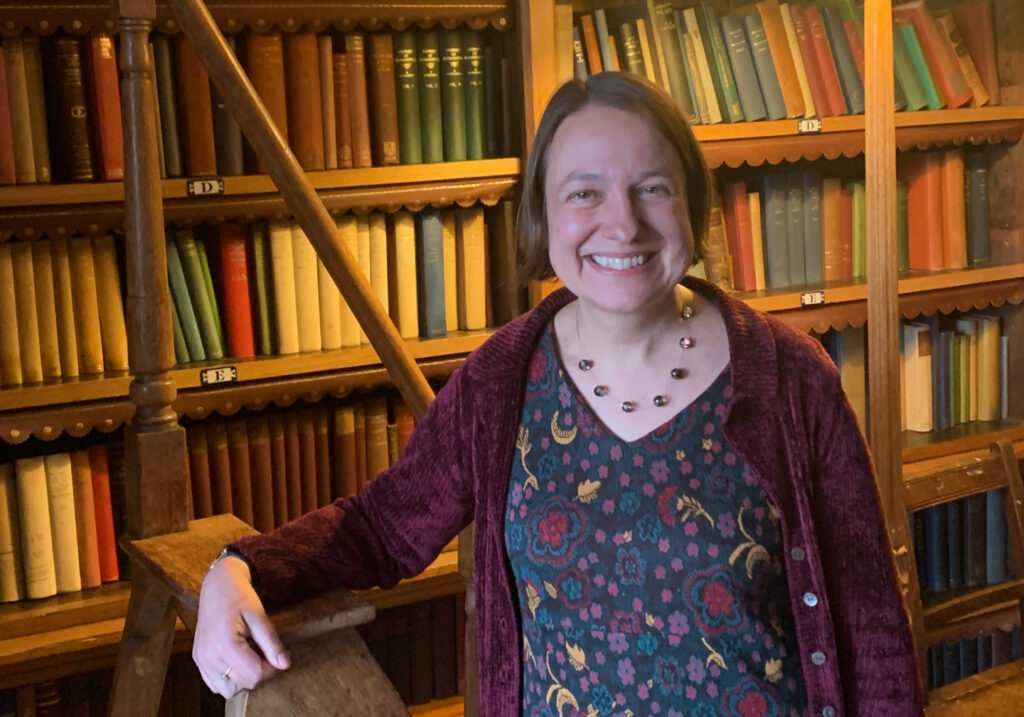
Paper Kingdoms 9: Tiffany Stern
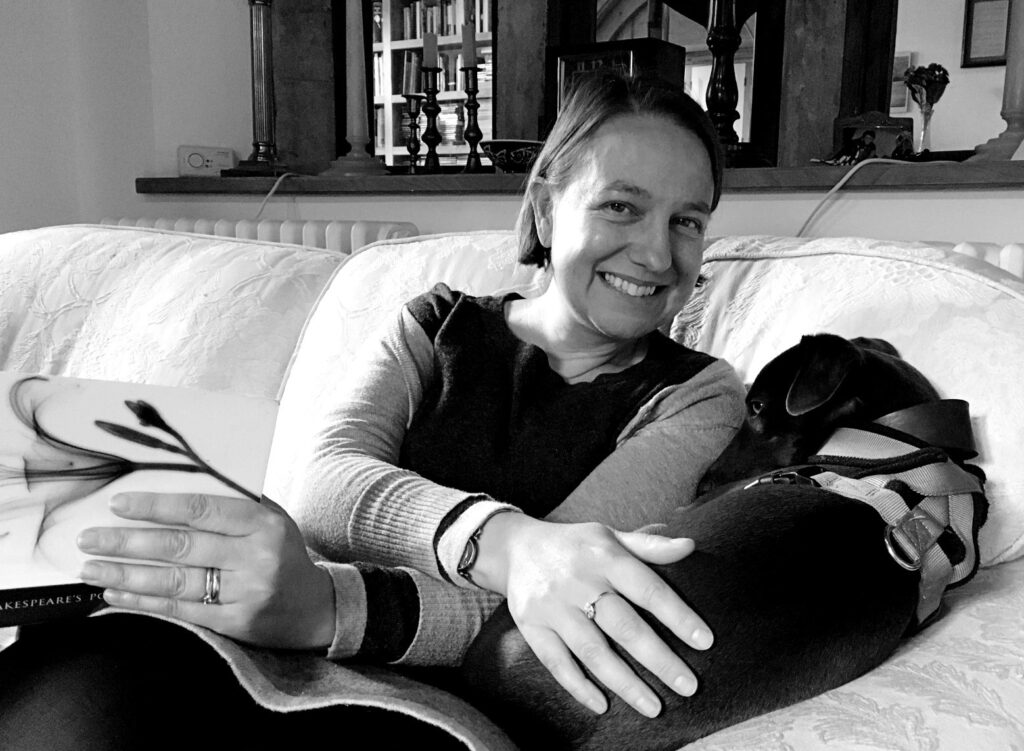
‘Comfy and cosy are important for me. I don’t write at a desk… I tend to be as I am now: laptop beside me on the sofa; the dog nearby’
Tiffany Stern, FBA, is Professor of Shakespeare and Early Modern Drama at the Shakespeare Institute, University of Birmingham.
Tiffany originally read English as an undergraduate at Merton College before she returned as a Junior Research Fellow after earning a doctorate at Emmanuel College, Cambridge. After the Merton JRF she held lectureships at the Jagiellonian University in Kraków and at Oxford Brookes. In 2005 was appointed to a Tutorial Fellowship at University College, Oxford, where she became full Professor in 2008. She left Oxford in 2016 for Royal Holloway before joining the Shakespeare Institute in 2017.
~
This interview with Tiffany took place across 2022 and 2023, both online and in person at her home in Stratford-upon-Avon. Usually I edit and publish these conversations over a period of a month or two; this time I’ve revisited the material after a few years. I’ll say more about that gap below.
Tiffany is by any measure one of the world’s leading early modernists. Her research is as impressive for its consistency as it is for its influence on the field. She has written or edited fifteen books. By my count, these include five monographs (six if we include the co-authored Shakespeare in Parts); two essay collections; six editions of early modern or Restoration plays; and an anthology or two. Not to mention over fifty essays or chapters and her being one of the General Editors for both the New Mermaids series and the Arden Shakespeare Fourth Series. The numbers alone are impressive but they don’t tell the full story. Many of her writings and discoveries have significantly changed the way early modern literature, particularly drama, is taught, understood, and enjoyed in universities and theatres around the world.
Sitting somewhere near the top of her many heroic accomplishments is the fact that Tiffany supervised my doctoral work; a feat that no doubt clinched things when the British Academy awarded Tiffany her Fellowship in 2019 (her British Academy lecture of 2014 is a wonderful introduction to some of her interests). This also means I approach her with a certain reverence. Do we ever fully lose that need for approval? I’m not sure that I want to, even if she might appreciate being let off the hook from time to time. I owe her a very great deal.
It is now 2026–three years since Tiffany and I spoke. In one section of the interview Tiffany described struggling with a feature of her ballad book. That book–Ballad Business: Selling Early Modern Theatre (CUP, 2026)–is now out in the world. Its contents leaf displays the solution she eventually found to the complexities of how printed ballads related to their dramatic counterparts.
My slow handling of this interview straddles another important change, which is that in 2023 I accepted a permanent job. Below I ask Tiffany about early career tactics–how can I get a job? Reading now, I wish I’d asked her about mid-career things: how to protect time for research while gathering other responsibilities; how to curate a subject culture with longer time horizons; how to publish one of these interviews in a timely manner. Other elements of our conversation seem only more relevant as time moves on. When she spoke about the cruelties of academia she meant its internal culture as much as its structural challenges, but her words address a growing mood in the UK as English departments reel.
Tiffany values clarity in her writing (and that of her supervisees). Striving to please, I once pored over Documents of Performance, the better to understand the rhythms of her thought. I marked up every instance of primary quote and argumentative assertion. What did I learn? That she truly is a gatherer, as she says below: almost every page showcases evidence from her ‘Duttons’, her files of primary material. That she is watchful of split infinitives and suspicious of fancy writing: I hunted for metaphors with which to tease her but found few. Her prose is lucid, authoritative, strongly structured, and steeped in an unrivalled knowledge of her subject.
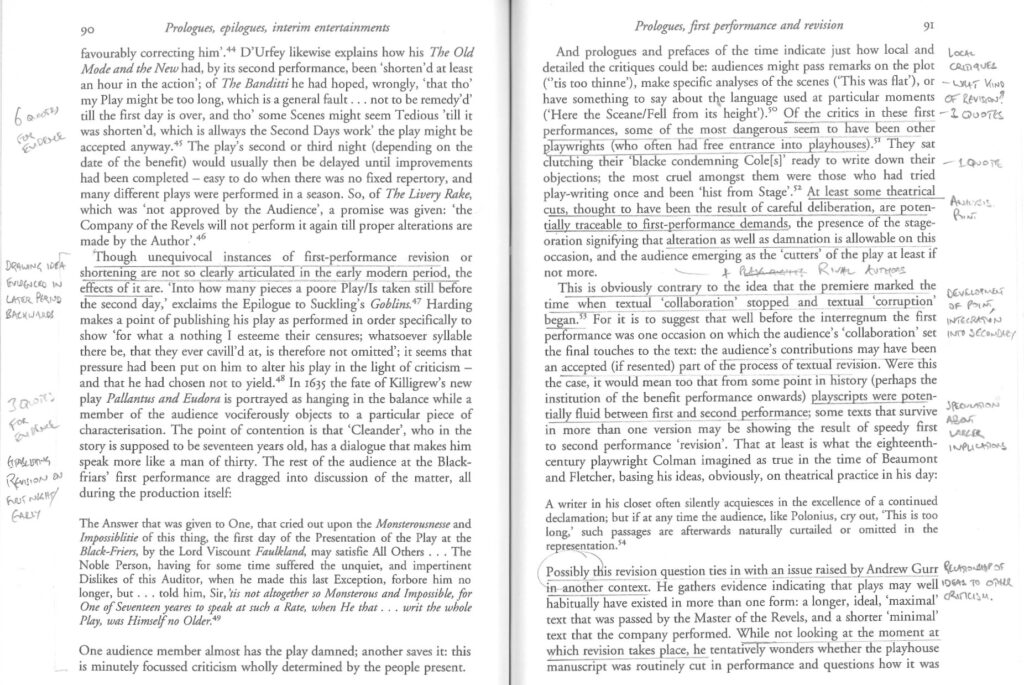
Her commitment to clarity is, I think, a form of respect for the primary materials: don’t push things too far; don’t distort or give in to rhapsody. Instead–seek, gather, think hard, then arrange, explain and argue with as much strength and fidelity as you can muster. Every now and then, when you have earned it, you may speculate. It makes sense to me that Tiffany is an editor as well as a literary critic because her mode of scholarship promotes ideas of service and responsibility even as it pursues fresh thought and fresh discovery.
Those values of service and responsibility also extend to the communities Tiffany has curated. This is another form of her gathering: the people of her social and intellectual worlds; her personable Duttons. Her sociability is found in the long list of people she mentions when I ask what she’s read recently–you can see the care with which she follows the work of those she knows and admires. You can also find that sociability at the bar of any conference she attends as those around are buoyed by her mirth. And I understand why she finds giving talks so valuable: Tiffany can hold a room and carry her audience through her thinking better than anyone I know. On a personal level it is in no small measure to Tiffany’s sociability that I owe one of my dearest friendships. The brilliant early modernist Jakub Boguszak was another of her supervisees. Somewhere in between our first nervous encounter with the antique sedan chair that used to preside over the entrance to her Oxford study, and last weekend’s trip to her Stratford tower, Jakub and I realised the remarkable value of our intellectual parentage.
The conversation is divided into four parts: (1.) Research Practice, in which we talk through her research tactics more generally; (2.) Problems in Research and Writing, in which she reflects on frustrations with finding the right structure for Ballad Business; (3.) Writing: Style and Practice, in which she touches on influences, fonts, and link words; (4.) The State of Academia, in which brief section she spoke honestly and pragmatically about the field; and (5.) Editing, about which I wanted to ask much more but became worried about her time.
(1.) Research Practice
INTERVIEWER
How does a new research project begin? Do you have any general principles?
TIFFANY STERN
Yes, I would say so. This question involves some explanation and starts with a Victorian man called Edward Dutton Cook.
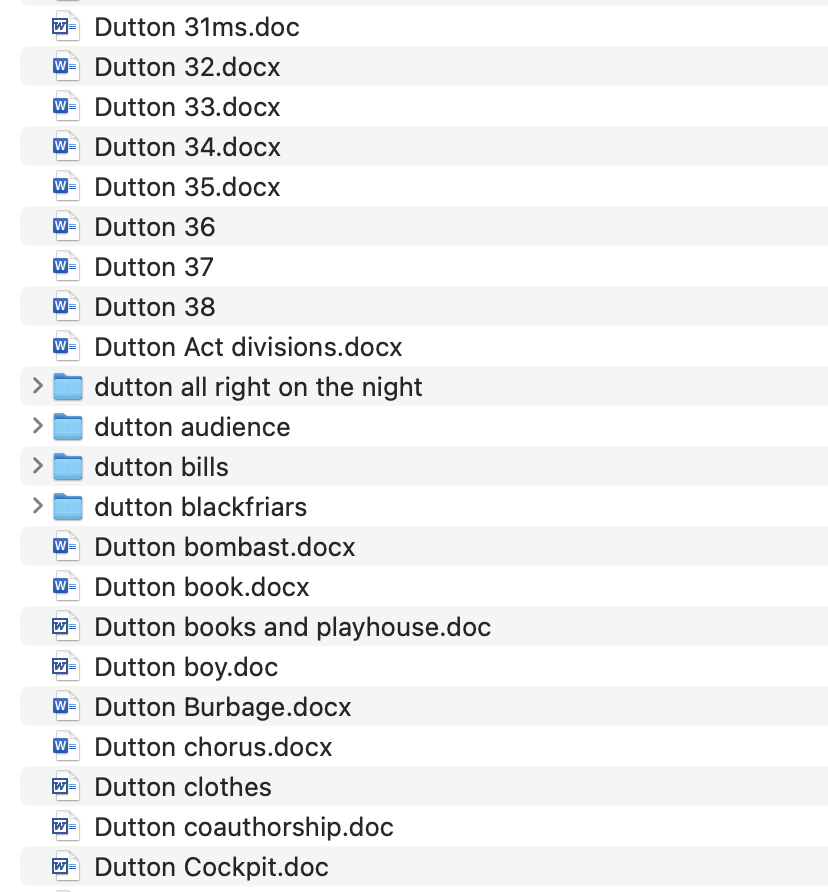
Perhaps twenty-five years ago, I was reading a book by Dutton Cook. I took some notes from that book and I called the document, ‘Dutton’. Over time, that document became a place where I stored primary information. When a document became so full that autocorrect kicked in and started altering the spelling of old words–which was after about 30 pages–I started a new Dutton. I now have, I think, thirty-nine files, ‘the Duttons’. They are just pools of information.
It became clear to me quite early on that there were whole areas where theatre and book historians hadn’t looked. For example, there was a prolific writer called Richard Brathwaite who wrote in the early seventeenth century. His observations about theatre from a couple of texts are quoted a lot. Noticing this, I decided to call up everything by Richard Brathwaite to see if there was more of interest in other, unquoted pieces he wrote. He wrote about seventy books in all; when I called them up I found out he writes about theatre in many of them. These books were full of gems that people didn’t know about.
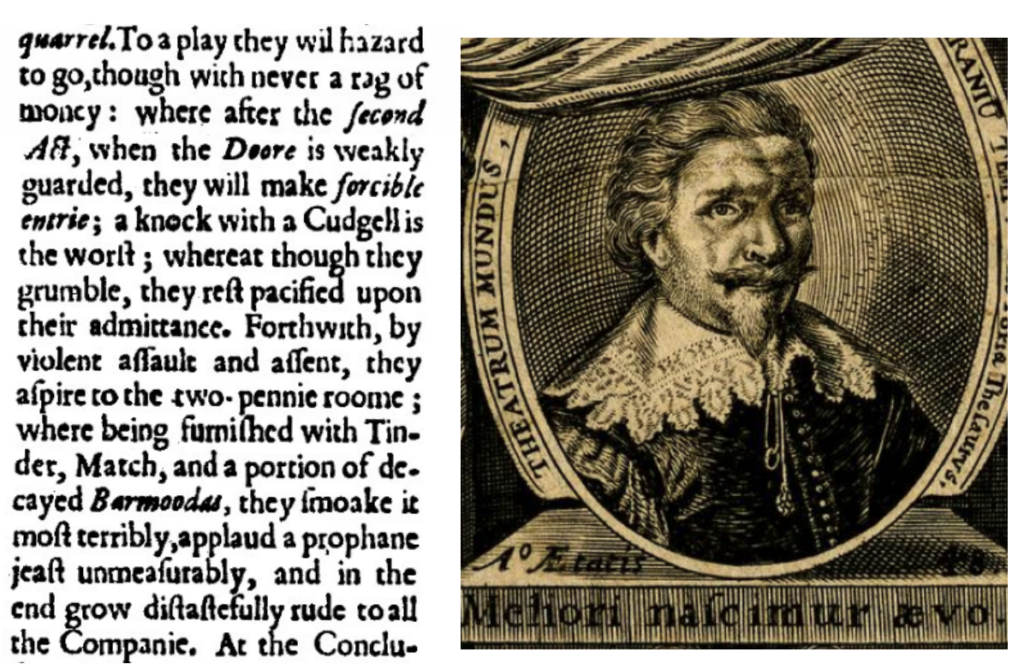
‘To a play they wil hazard to go…’ Brathwaite’s sketch of ‘A Ruffian’ forcing violent entry after act two supplies material for Tiffany’s Duttons: Whimzies (1631, STC 3591), G5v-6r. Brathwaite’s portrait, engraved by William Marshall, is from the title page to A Survey of History (1638, STC 3583a), image from the British Museum and used under Creative Commons Non Commercial (CC BY-NC-SA 4.0) license.
Over the years, whenever someone early modern mentioned theatre in an interesting way, I added their name to the bottom of my list and called up everything by that author. Then I would call up related things in the Bodleian. For example, in sammelband bindings, like is sometimes pooled with like. So, if there’s one author there talking about theatre, sometimes the other ten books in that binding will also talk about theatre.
That’s how my Duttons grew. And now I have this big pool of undifferentiated raw material that I add to all the time. And so, to answer your question, where I go first, when I write anything, is to the Duttons. I pull out all the raw material I have on that topic and I look at it. That raw material also gives me a series of early modern words that I can use in Early English Books Online
searches and so forth. And that in turn can yield more material.
INTERVIEWER
Your research habits look to adjacent and associated things, whether those things are gathered in a sammelband binding or dispersed across an author’s career. It also suggests an openness to serendipity, because you don’t know what you may find when calling up a sammelband volume. What happens to serendipity within the specificity of digital archives?
TIFFANY STERN
Physical research is an intense form of browsing. Discoveries are made through a mixture of serendipity and working out other people’s habits of organisation. When I go to a library I often think ‘where do you have the things that no one knows about?’ Sometimes that’s the material catalogued as ‘miscellaneous’, or sometimes it’s in Victorian scrapbooks (they tend to be catalogued under the name of the person who collected them, but sometimes they include early modern documents, for instance). So physical research yields particular kinds of discoveries. You can’t do that kind of thing with a digital catalogue.
That said, I feel really lucky to live in an age when there is a better early modern rare book library available on my computer than in any physical location. Early English Books Online is amazing, and of course it offers other ways of making discoveries: word searches, proximity searches and so forth. Using it one can look up, say, all the works of one author or one publisher. So, ideally, I would want to do a bit of both: real library research and online research.
INTERVIEWER
You now have thirty-nine Dutton files. In practical terms, how do you use those files?
TIFFANY STERN
You can word-search them, but they also have an index. My system is terribly old-fashioned because it was set up over twenty years ago. For example, there will be in the index an entry for “props”, and any piece of evidence I have that mentions a stage prop will have its Dutton document and page number noted by it.
Sometimes the process of updating the index alerts you to things that could become articles. You suddenly realise that you have a lot of references to false beards or trumpets or something. A lot of my work has come from an entry in my indexing.
In the olden days, I used to index my Duttons on aeroplanes. Or, sometimes when a bit drunk (this is work you can do that’s kind of boring and time-consuming but must be completed to enable more interesting work). I don’t have quite as many clear moments these days, so I’m a little behind on my index.
‘I now have, I think, thirty-nine files’: the Duttons (right)
INTERVIEWER
Some of the notes in your Dutton files may not pay off for years, if ever. Could you say something about that mode of patient research that resists the clamour of deadlines?
TIFFANY STERN
I think because my doctorate was a history of rehearsal, and was itself a gathering, it put me in the gathering mode. It also taught me there are whole areas of our field that haven’t been gathered. I like being a ‘collector’, but of nuggets of information rather than physical things.
After my doctorate I was lucky enough to have a Junior Research Fellowship and suddenly I had three years of pure research time. I went on gathering in this slightly blind way before knowing what I was gathering for. That experience made me realize that I should just always gather. For (a.), it will reveal things; and (b.), the bigger the pool, the more possibilities. Since then, I haven’t stopped gathering.
INTERVIEWER
You mentioned a separate document for secondary criticism.
TIFFANY STERN
Yes. I put together the secondary critics who have written on that theme. I’m generally anticipating not quite agreeing, because I will almost certainly have more primary information than they, and I’m trying to be led by that information rather than a scholarly line. I tend to read secondary critics in a slightly combative way.
So I have two documents. A primary document, which is what I think from, and a secondary document, which will be how I position the primary information.
INTERVIEWER
Do you make fresh documents for each topic?
TIFFANY STERN
Yes. So for an essay on Trumpets, I’ll have secondary critics on trumpets and I’ll have my primary stuff.
The next step is that I’ll boil all that material down. So I have a document in red called the ‘Elements’, and that’s my summary of the primary information. Then I have a document in blue called ‘Secondary Elements’. I map out the shape of an article or chapter by drawing on those two documents, meaning my map will have red and blue bits
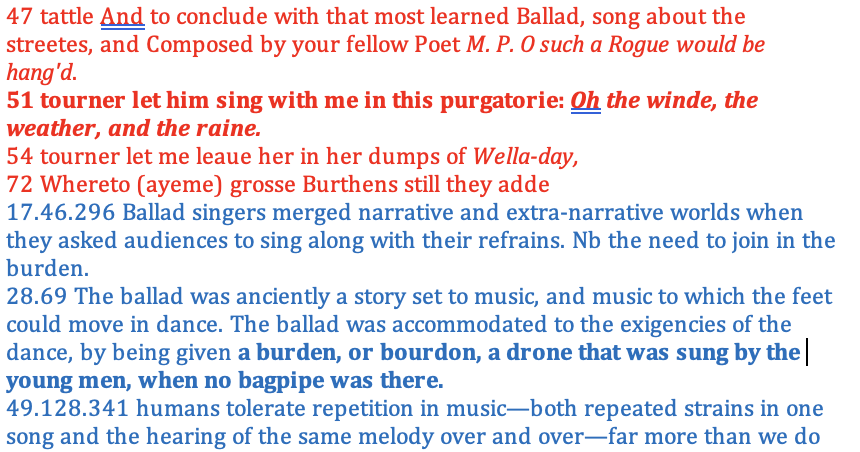
A chapter map from Tiffany’s ballad book project: the plan merges primary (red) and secondary (blue) elements
INTERVIEWER
For each essay, you’re left with an archive that captures layers of your process: from Duttons, to Elements, to a plan that merges Elements, to a written Draft.
TIFFANY STERN
Who knows how one comes up with these things? But by the time I’ve interspersed those documents, I can usually write the article or chapter even in quite a busy term, because the structure and information is there.
The other thing, though, is that there are ‘clever days’ and there are ‘not clever days’. You have to write on not clever days, but the work mustn’t be submitted till it’s been reviewed on a clever day. I never know when a clever day is going to come and it never turns up conveniently.
INTERVIEWER
Could you say more about clever days?
TIFFANY STERN
I once got obsessed with trying to predict them. I thought that if I knew when a clever day was coming, I would be able plan my work better. So I asked: do they have anything to do with whether I’ve slept well, or whether I’m stressed, or whether I have a hangover or are they latched to my female cycle? It became clear that clever days don’t relate to anything obvious.
What I’ve concluded is, when you’ve mostly written your work and the material has been mulching and you’ve been thinking–then suddenly there’s a day where clarity occurs.
INTERVIEWER
At some point in a project you need to find your overarching arguments. How do those larger claims coalesce out of your raw materials?
TIFFANY STERN
For this I have another document, which is called ‘Own Thoughts’, which is cumulatively written while I’m going through a project. I usually hope that ‘Own Thoughts’ will generate the larger claims.
INTERVIEWER
To summarise: the process starts with your Dutton files. From those Dutton files come the two Elements files for a project: primary and secondary. Then from the Elements documents emerges a kind of conjoined document in red and blue, which is your plan. And parallel to all of this is the ‘Own Thoughts’ document. From these documents, the project arrives.
How is the hard graft of intellectual labour arranged within this distributed research and writing process?
TIFFANY STERN
The thought really happens once I’ve got the pool of primary information and can read through it. The intention is that the primary information tells me its argument and I just articulate that. I’m sure that’s not quite the case, but I feel as though that’s the case.
So sometimes I think I’m never really being smart or original myself, I’m just saying what the information says. The novelty may come from asking a new question – but even that often arises out of the information.
INTERVIEWER
Is there anything else that you’d like to say about your research process?
TIFFANY STERN
Let me see. Sometimes if I want to keep in a steady state of mind, I ask my husband Dan, who is a musicologist, to suggest the right kind of music to listen to. That helps.
I don’t give written talks. I always talk to slides; these days, on Powerpoint (I used to be ‘the Transparency Lady’ once). The slides are generally made up from primary material: the Duttons. I show the information and I say where my thought has got to based on the information. I find it very helpful to give a would-be chapter as many outings as possible as an extemporised talk to slides, and to take questions. I find audience feedback enormously enriching. I don’t write something down until it’s already been verbally peer-reviewed, by talks and questions, as it were.
I very much like pictures for talks. Once I’ve got an early modern vocabulary, from the Duttons, I often go to Google Translate and use the translated terms to search for images of my thing, if it is a thing, from other countries of that era. I often get better illustrations this way, because English visual culture from the time is so limited.
My last thought: if you ask the question next to the question everyone else has been asking, that can sometimes be incredibly fruitful. So, if everyone is asking: How is it performed? Then perhaps no-one has been asking: How is it rehearsed? This is another habit that helps me a lot: find the question everyone has been asking, and then look for the adjacent question.
–
‘If you ask the question next to the question everyone else has been asking, that can sometimes be incredibly fruitful… Find the question everyone has been asking, and then look for the adjacent question.’
–
INTERVIEWER
What thoughts do you have about the future direction of your field? Are there questions or topics you see recurring?
TIFFANY STERN
That’s a huge one. I suppose I’ve two subfields, theatre history and manuscript/book history, and both are old and established and importantly underlie all other work in early modern drama. As they are ways of pooling and thinking about information, and as more information is available now than ever before, they are both in a really good place.
Archaeology is providing a whole new resource for theatre historians – new findings, like the remains of the Curtain, and the cataloguing of old findings, like the Rose, have revealed fresh areas for research. Book and manuscript history are better resourced than ever now that so many libraries are, wonderfully and generously, putting their material online for everyone. This is a great time to enter either field.
Sometimes, however, archival research is thought of as staid or backwards-looking. In fact, though, this research is essentially ‘history’, and each generation looks to history and makes discoveries by asking it current questions. I’ve students doing exciting work on early modern wooden theatre structures and eco-criticism, and on umbering, cosmetics and race. I myself have become interested in the physically impaired and often female ballad singers who surrounded early modern playhouses, and would have been the first performers encountered in the theatre space, before encountering those hale and male white actors inside. In other words, both fields are always up-to-date if you ask them up-to-date questions.
As new areas of thought and study for the rest of English Literature often arise from early modern scholarship, so the future direction of our field more broadly is likely to come from a student in one of those historical fields asking the next great question. What will it be? If it’s to do with people, something to do with class, perhaps; if a thing, maybe sewage; if an attitude–I hope the future will involve being allowed to like literature again. All the rage and anger currently about is a threat to our subject. Let’s–in thoughtful and nuanced ways, of course–allow ourselves to get and teach joy from the subject we all went into for love.
~
(2.) Problems in Research and Writing
INTERVIEWER
Could you describe a problem you’ve encountered in your research or writing process?
TIFFANY STERN
I am currently grappling with such a problem. Usually, my argument for a piece of work arises directly out of thinking through my primary evidence. For my current work on ballads, though, my pool of information can be read in several ways.
INTERVIEWER
Could you explain that a little more?
TIFFANY STERN
I have been looking at two fields: the field of ballads and the field of plays. I intended to tell a story about ballads as a form that was ancillary to plays. But it became clear you could read the primary material another way, in which the plays were ancillary to ballads. And also in a third way, in which both forms interconnect in unpredictable ways. Sometimes one form is a source to the other, or sometimes both tell a version of the same story but have a third different source that is a chapbook. The story of their connections is complicated.
To write a book, you need a narrative. Yet I felt any narrative would impose a structure that would flatten the primary material. I still haven’t solved this problem. I’ve got all the information, and I’ve part-written the book in two different ways, and I don’t know if I can bring them together.
Generally, when I have this amount of material that is fresh, the book writes itself. But this book won’t write itself. I’ve got the material and I keep excitedly rethinking new orders in which to arrange it.
INTERVIEWER
Another of your books, Documents of Performance, fragmented one recognisable form of literary work–the early modern play–into its constituent parts. ‘The play’ was broken up into plots, playbills, songs and so on. The meaning and interest of those smaller texts were partly about their relationship to the larger form of the play.
For this project, it sounds as though you are again moving between different forms–ballads, chapbooks, playbooks–but haven’t yet found what the central form is to which the others relate.
TIFFANY STERN
That absolutely is the problem. Maybe the thought that led to Documents of Performance also guided my idea of what to write next. I thought originally the book I would write would be Documents After Performance. My idea was that having explored all the documents that make up a play, I could now address all the documents that are produced afterwards, including the printed play itself, but also things like chapbooks and ballads and all kinds of other documents.
That was the book I proposed: Documents Beyond Performance, or After Performance. That’s still a book I wouldn’t mind writing, but it became massive because I realized there were all kinds of documents beyond performance. For example, is an adaptation of a play a document beyond performance? The project became overwhelming.
So at the moment, my ballads project has a complicated structure that amounts to: “sometimes this, sometimes that”, and it doesn’t have clear moments of payoff.
Perhaps that just means I need to learn to write differently. I’ve had the research I needed for some time. Usually once I’m at this point, the book just pours out. And this book just–hasn’t.
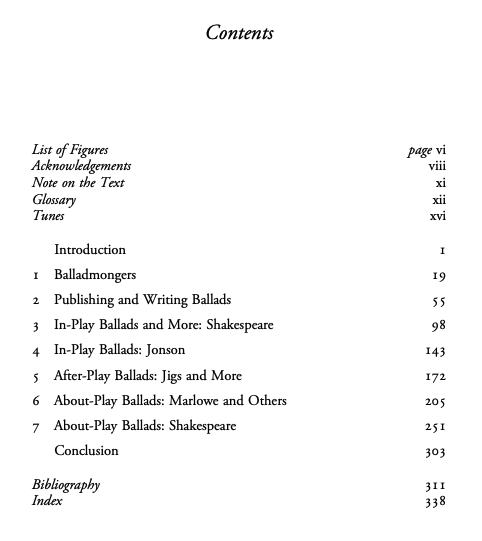
How to structure a ballad project: the contents leaf of Ballad Business: Selling Early Modern Theatre (CUP, 2026) shows the ‘in-’, ‘after-’ and ‘about-’ framing on which the project eventually settled
INTERVIEWER
How have you responded to this problem?
TIFFANY STERN
I pushed it all aside and wrote a short book on eighteenth century scholar Malone’s Shakespeare chronology–and how it’s fascinating and a bit wrong, meaning that our chronology (ours is his) is also fascinating and a bit wrong. So, my solution was to think about something else entirely that has likewise bothered me, but for which I know the narrative.
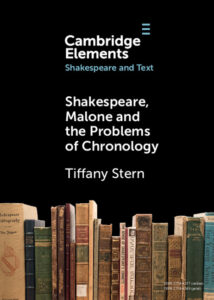
I think that strategy was helpful. What I had wasn’t precisely writer’s block, but I did feel hampered and slow. I’m used to writing quite a lot, quite regularly. This lack of writing was getting to me.
I also felt I owed Birmingham a good book for having given me such a great job. I also had some big editorial jobs to do. So writing the Malone and chronology book helped me to keep working.
INTERVIEWER
What would be the perfect piece of evidence for you to discover for this project? If you could conjure an ideal thing from an archive?
TIFFANY STERN
I have wrestled with the fact that ballads are hard to date. For example, there might be one version of a ballad that survives from 1636, but a reference might make clear that it also existed in 1584. That’s very normal. So from when does the ballad date? In no way do its words date from the 1636 bit of paper that happens to survive.
In one sense, I would like to have clear dates for everything so that I could work out their relationships to each another. But if I had clear dates for everything, maybe I wouldn’t have a book to write. The Malone book certainly wouldn’t have happened with correct dates for everything.
Truthfully, I don’t want solutions. You think you want answers, but you don’t. What I mean is, you don’t necessarily want to find a bit of paper with a magic list of dates. It’s often more interesting and evocative to say: ‘We can’t quite ever know, but we now know slightly more, about this question that only I have asked’.
In a way, what’s most exciting is how you get the information to raise new questions. I try to suggest answers to questions that people haven’t thought to ask: if the answers are wrong, the questions at least are evocative–and may lead to more questions.
INTERVIEWER
We first spoke about this problem with your ballad work around a year ago. Has your thinking about this impasse evolved since that time?
TIFFANY STERN
Yes. I’ve just finished the book. Hurrah! Talking to you, here, was helpful. But what really cracked it was talking to my wonderful friend Tanya Pollard over a drink at the Shakespeare Association of America. I told her my book had stagnated, gave her my topics and thoughts, and she then said them back to me in a different, better order, and told me what she thought I was saying. She was right and she cracked it! Somehow, after that conversation, I was able to come up with a plan, and after that, the book was quite speedily written. Tanya! I owe you so much!
~
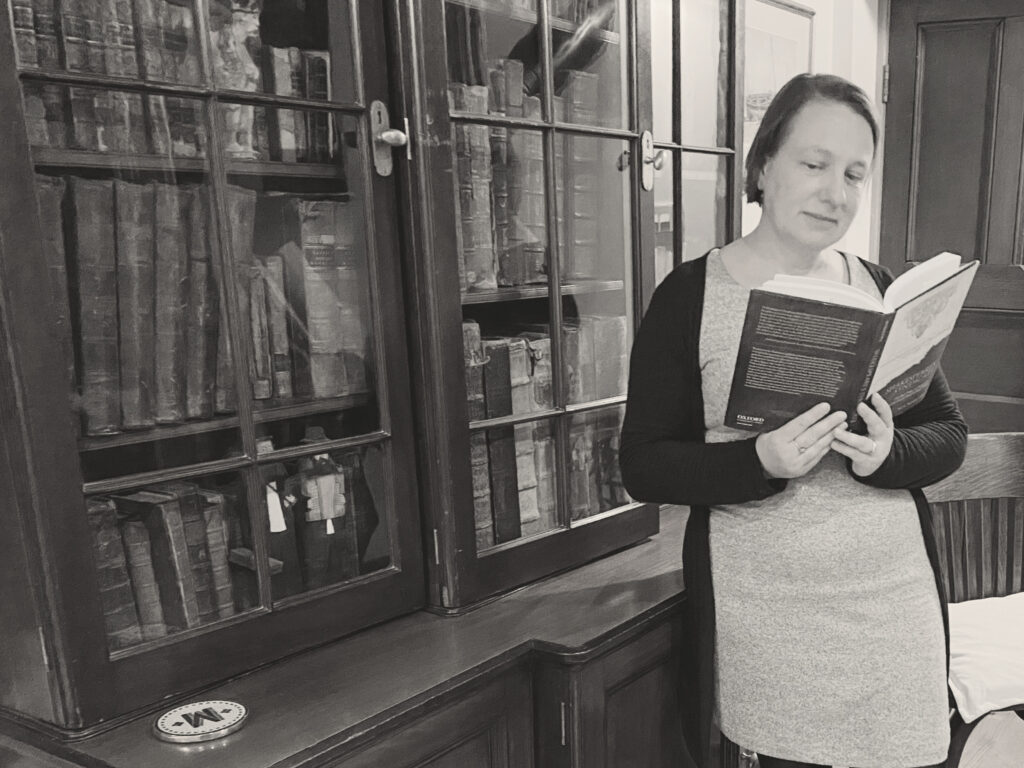
Tiffany lost in reading what is, by any measure, a generationally significant work of exceptional scholarship
(3.) Writing: Style and Practice
INTERVIEWER
How would you describe your writing style?
TIFFANY STERN
I strive for clarity. I don’t have a beautiful style and I’m wary about anything that sounds clever for its own sake, uses words people don’t know, or is written to be too emotive. I try instead to be intensely clear and focused on the primary information and on why I’m drawing my conclusions.
The danger is that my approach can come out as quite worthy and a bit lawyerly. Sometimes I think: ‘Gosh, I do really like or am moved by the beauty of this thing I’m reading’. But possibly you couldn’t tell that from the way I write.
There’s a bit of me that wishes I was more lyrical in writing. But then, when co-writing with Simon Palfrey, we got into arguments a lot because I would say: ‘You’re saying a beautiful thing because it sounds beautiful, rather than because it is the case’. And he would say that I had a flat style. Actually that relationship was really productive, and together we produced a book that neither of us could have independently. But we thought and worked–and wrote–in very different ways.
INTERVIEWER
Do you use metaphor?
TIFFANY STERN
Not often. And–as you may recall–I’m often quite critical of students’ metaphors. Metaphors work when they add, but not when they confuse (and they often confuse, because they are about an analogy, not the thing at hand). In general, I think metaphors are better inside works of literature than works of criticism.
INTERVIEWER
Which authors have influenced your own writing?
TIFFANY STERN
People who’ve influenced me for their content are bound to have influenced me for their writing. In good and bad ways, that will often be writers of the twenties, thirties and forties, who wrote before our subject became so theoretically tangled: E. K. Chambers, or W. J. Lawrence, or Thornton Graves. These old theatre historians and book historians, such as W. W. Greg, who wrote with great fidelity to their documents are often my models.
I’ve just been writing about Edmond Malone, the eighteenth-century editor and inventor of theatre history and chronology and so many other things. He was originally a barrister, but then turned his forensic mind to work out all kinds of amazing things about editing and theatre history. I see myself at the end of a line that started with Malone and went through those other people I’ve named. None of them are lyrical writers, but usually they make a clear, historically based point. You admire them even if you disagree with the point. If you disagree with the point, it’s usually because you’ve now found some more historical information. I think my writing comes from that school. I also think it’s traditionally quite a male school, although possibly that is simply because every scholar was male at the time.
INTERVIEWER
Is your physical environment important for your writing? Do you write in a particular place?
TIFFANY STERN
Comfy and cosy are important for me. I don’t write or work at a desk, which is probably why I have such a bad stoop. I tend to be as I am now: the laptop beside me on the sofa; the dog nearby (or on me: she’s a very cuddly dog); a cup of tea or coffee on hand. I am happy and at peace. I write mostly at home; I love the library for research, but I don’t write there.
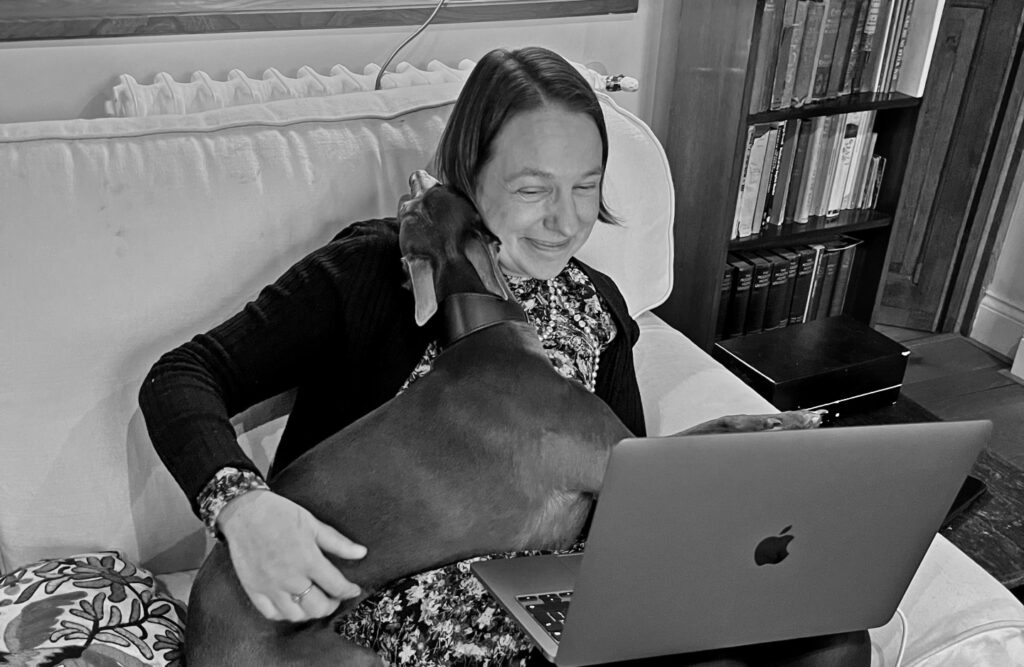
Tiffany Stern, Co-Author
INTERVIEWER
So writing happens mostly at home.
TIFFANY STERN
Yes. I love the library for research, but I don’t write there.
INTERVIEWER
When do you write?
TIFFANY STERN
This has changed as I’ve aged. It used to be that I was at my sharpest in the evening, which was bad news because that’s when I would socialise. Now, I fall asleep in the evenings and I’m at my sharpest in the mornings. I’m not sure I’ve worked out precisely what time of day is best with this new version of me.
INTERVIEWER
Do you use special writing software?
TIFFANY STERN
No. I use Microsoft Word. I think all my methods got invented about twenty years ago or more and I’ve stuck with them.
INTERVIEWER
You’ve said that you use different colours in your writing to distinguish between primary and secondary elements. Do you care about the font in which you write?
TIFFANY STERN
No. I currently use Calibri because that’s what Microsoft Word offers you by default. There are beautiful fonts out there, but, if anything, the beauty of the font might trouble the writing process. You want to be thinking about what you’re saying, not how it looks.
INTERVIEWER
Do you know when your writing is good?
TIFFANY STERN
I know when it’s impassioned.
INTERVIEWER
Does that mean good?
TIFFANY STERN
I’m not sure. I think everyone has written something they’re delighted by and then read it the next day to discover it’s the most embarrassing rubbish. These responses are so determined by mood that I find it very hard to judge my own work. Except, usually I can tell if the writing has become dull. If you are pooling too many facts and not thinking enough about them, then writing goes dull easily. Some bits of writing are harder to judge than others. The conclusion is one of those passionate moments which might be good, or might be where you’ve let your point get away with you.
INTERVIEWER
What should the ideal conclusion do?
TIFFANY STERN
Encapsulate what you’ve said briefly, and then–if possible–there should be a ‘hey presto’ moment when, to use a metaphor (I know, I know) you pull a rabbit of a hat. New thought! New idea! New possibilities! New future!
INTERVIEWER
Has your writing changed over your career?
TIFFANY STERN
I think it’s ossified a bit. I’ve now got habits of writing. I have some slightly lazy link words, for instance. I know that I must do a ‘find and replace’ check for ‘clearly’, because if my point is in fact clear then I don’t have to say so. I think my writing has become easier to do but perhaps less smart.
INTERVIEWER
Do you share material in draft?
TIFFANY STERN
Not while I’m in the process. When it’s done, I might ask then for feedback.
INTERVIEWER
What academic writing have you recently enjoyed in your field?
TIFFANY STERN
Because I’ve been writing on ballads, I’ve been reading fascinating work by a whole set of people I’d not studied before: Christopher Marsh’s rich scholarship is revelatory, and I’ve loved getting to know the work of Angela McShane, Una McIlvena, and Simone Chesse. And Patricia Fumerton set up the wonderful EBBA (English Broadside Ballad Archive) website as well as having her own very important take on ballads as ‘moving media’. I owe it and her anything.
And then: what joy to discover in that new field, exceptional work by some old and revered friends: Bruce R. Smith, Fran Dolan, Sharon Achinstein, Katie Brokaw. In theatre history, William N. West’s recent book Common Understandings, Poetic Confusions [Chicago, 2021] finds new evidence about the relationship between audience and plays through studying the figurative language they use. So exciting! Holger Schott Syme’s splendid element Theatre History, Attribution Studies and the Question of Evidence [CUP, 2023] is questioning givens and destablising the field in really productive ways. Paul Menzer’s work is a joy as it’s always as entertaining as it is brilliant: he’s just written the only laugh-out-loud biography William Shakespeare: a Brief Life [Bloomsbury, 2023]. I can’t stop giving it to friends as a gift. Anything by Lucy Munro and Clare McManus of course is revelatory (we’re all very excited to read the outcome of their current work on women and performance – there was so much more of it than we thought – in the early modern period).
The whole idea of early modern clowning is shaped by Richard Preiss’ amazing Clowning and Authorship in Early Modern Theatre [CUP, 2014], a book I turn to all the time; James C. Marino’s Owning William Shakespeare [UPenn, 2011] should have reshaped our attitude to book and theatre history more – have a look at it!
In book history, Zack Lesser’s recent Ghosts, Holes, Rips and Scrapes [UPenn, 2021] makes bibliographical detective work thrilling. And then (am I allowed to boast about students?) I’m so proud and excited by great work that is coming out from former students: your book, Ben, of course: Shakespeare’s Syndicate [OUP, 2022], which studies the financiers of the First Folio–and reveals that to understand them is to understand the Folio differently–and Jakub Boguszak’s The Self-Centred Art [Routledge, 2021], which divides Ben Jonson’s plays into actors’ parts and analyses them that way, throwing a whole new light on Jonson, as well as showing how to analyse ‘parts’ that are not by Shakespeare. As I said above, this is an exciting time for scholarship.
~
(4.) The State of Academia
INTERVIEWER
Both academia in general and the humanities in particular are suffering at present. What is your sense of the future for our industry?
TIFFANY STERN
The biggest danger to our field is us! I worry that we are soul searching in the wrong way and are well on the way to destroying our own subject. We’ve got to allow students to like literature, we’ve got to learn from the past not just blame it, and we’ve got to show how analysis feeds the brain and aesthetic joy feeds the soul. And we can do it! But it all depends on us–or, rather, you, early career scholars and future academics.
INTERVIEWER
Thinking about early career scholars, are there general principles of advice you would give to those wanting to succeed?
TIFFANY STERN
There are certain practical things one can say. Early career people should have two CVs on the go: one that’s teaching-led and another that’s research-led. All temporary jobs are essentially teaching jobs, but for all permanent jobs, it’s your research that will get you the post. Early career people mustn’t drop the ball on one of these CVs because of the other.
When you write a cover letter, go through the job advert, see precisely what it asks for, and then shape your letter around it, matching it point by point (I’ve read too many letters that are general boasts rather than being tightly linked to what the job has asked for). Maybe that’s me doing a kind of, Dutton and Elements thing. But my advice would be: always write the letter a job has asked for, not the letter that you’d ideally like to send or that you already have on file.
INTERVIEWER
How important is it to have a monograph?
TIFFANY STERN
I think it’s a prerequisite for the time being. You mustn’t become a brilliant teacher who then forgets about publications. That can happen because teaching is instantly affirming while publication takes so damn long. Even when you’ve got the monograph out, of course, the world doesn’t notice for about three years: but do it, because that’s your unique contribution to the field. Only you could have written your book. Someone else could have taught your class (not as well, necessarily, but they could have done it).
In this competitive world, I think you need a ‘brand’ of yourself. And you must promote that brand. I don’t really approve of this mentality but I think a ‘known quantity’ person is more likely to get a job.
So if you are an early career academic, you must get out there and give talks in your unique way and tweet about your unique way of thinking about things. I fear that being too shy and modest isn’t helpful in this day and age. Oh–and be a nice person, enjoyable to have around. When choosing who to employ from a strong field, you’re likely to be drawn to the person you think would be positive in meetings and fun to have a drink with after work.
INTERVIEWER
Do you have any other guidance for younger academics?
TIFFANY STERN
This is crucial: embolden yourself for constant rejection and meanness. If you get damaged by cruelty, you won’t survive in this surprisingly bitter profession. Expect many rejections before you get a job; expect bad reviews before you get good ones; expect petty jealousies that have nothing to do with what you’ve actually written or said to shape the way it is treated. Expect constant cruelty and be okay with it because you know your own worth, whatever other people say. If you don’t have that attitude, you’re just going to suffer so much.
It’s particularly important for early career people to develop a hard carapace because at some difficult stage the institution will stop caring in the same way that it does for doctoral students or for postdocs. At some point, you won’t have a supervisor or mentor to say ‘well done’, or ‘you should maybe take a weekend off’. You’ll be on your own and you’ll have to give that advice to yourself.
–
‘Embolden yourself for constant rejection and meanness. If you get damaged by cruelty, you won’t survive in this surprisingly bitter profession. Expect many rejections before you get a job; expect bad reviews before good ones… Expect constant cruelty and be okay with it because you know your own worth, whatever other people say.’
–
INTERVIEWER
Did you always have that inner steel?
TIFFANY STERN
I had some self-belief. That belief may or may not be grounded, but if you don’t believe in you, then certainly other people will not. You have to bolster yourself with your secret belief in how good you are no matter what anyone else thinks.
(5.) Editing
INTERVIEWER
You are a General Editor for the Arden Fourth Series. What makes this series distinctive?
TIFFANY STERN
A major edition will usually tell individual editors what they should edit to. So, all texts in that series will seek to represent the author’s final draft, or the play’s first performance, or the revised text, for example.
For the Arden Shakespeare Fourth series, we are asking editors to decide what texts have descended to them (foul papers, public theatre text, scribal text for readers, court revival) and then what they’ll edit that text to, and give a rationale to justify that decision. We hope that will give every editor a bit more ownership of their version of their text, while reminding readers that editors are, like directors, people who make choices (rather than objective voices of rightness). We hope that will lead to teachable editions in that the editor’s approach to the text will be one of the subjects of discussion.
INTERVIEWER
You are editing The Tempest for this series. What is your vision for that play?
TIFFANY STERN
For The Tempest I’m lucky because there’s only one text in the First Folio. I agree with other people that the text we have was written up for the page by Ralph Crane, the scrivener in the 1620s. But was he writing up a version of The Tempest that was put on at court for the Palatine wedding in 1613?
What I think we have in The Tempest is a 1613 court text that was written up for the page by Ralph Crane. I am editing it back to the 1613 wedding performance, so removing purely scribal signs, and thinking particularly about court performance. I’m doing this partly because I think that state of the text is closer and more accessible than the 1609 text of the play (if that is when the play was written).
I will look at the other plays put on at court at the same time and study what we know about the wedding clothes and the colours and jewels of the audience and so on. And I’ll see whether this 1613 courtly information feeds into my text in interesting ways. I think music was added for court, for example.
I also want to remove some stage directions that I think were added by Crane for readers. I would still collate those directions, so they won’t be absent. But I have to think: what has a professional scrivener like Crane added? His stage directions are often long, chatty, characterful–and also have inaccuracies, meaning he includes things that cannot be staged. Can I de-Crane my play?
INTERVIEWER
Could you give an example?
TIFFANY STERN
There are things like, ‘Enter Arial invisible’. Is that direction just for the reader? Because if it is, I can remove it. Or on the other hand, is there a performatively invisible way in which one can enter?
These are the questions I’m working through and I might change my mind. But I think I will remove some famous stage directions, and possibly some people will complain. But others will discuss the issue and perhaps to teach a class on how stage directions relate to texts that are read. Or wonder whether stage directions can simultaneously be reader directions. Or even simply ask who was Ralph Crane? In removing Crane, maybe I’ll be able to promote him too: one of the Folio’s forgotten (anti)heroes.
~